


For Businesses
Restaurant, Café and Small Office Furniture: Bulk Orders in the UK
What to check before buying twenty chairs for a restaurant, café or small office, and how a bulk order with free UK delivery works with us.
4 min read

Virtual staging is legal in the UK, but an unlabelled digitally furnished photo can mislead. What the DMCC Act changed in April 2025, and how to stay clear.
By Furniture1004 min read
An empty room photographs badly. It gives a buyer nothing to judge scale against, no sense of where a sofa would sit, and no reason to linger on the listing. Staging fixes that, and virtual staging fixes it without hiring a van. The catch is that a photograph is a statement about a property, and since April 2025 the law governing that statement in the United Kingdom is not the one most articles on this subject still cite.
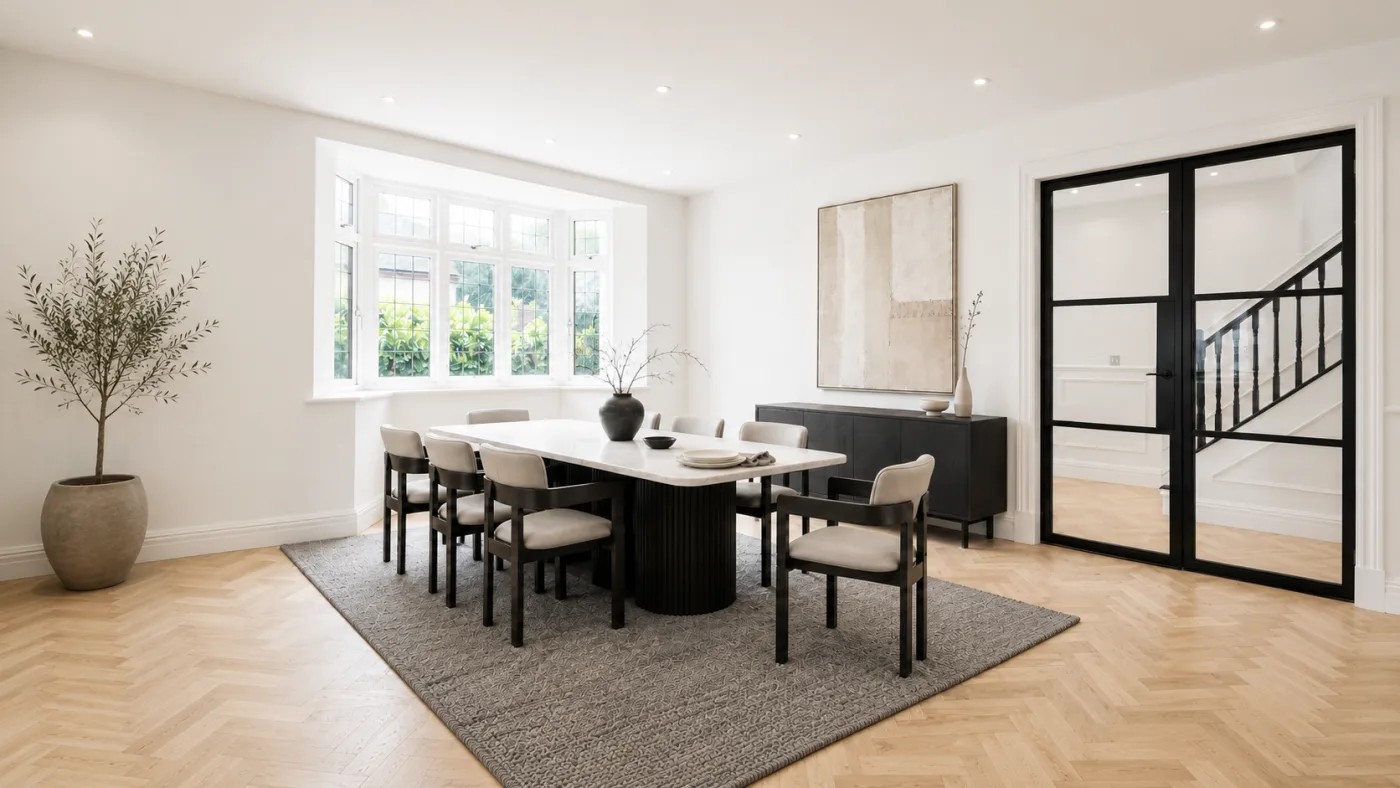
Virtual staging is the digital furnishing of a real photograph. You photograph the room as it stands, and furniture, lighting and soft furnishings are composited into the picture at the right scale and perspective. Nothing physical moves. The room is real, the walls and windows are real, and the sofa is not.
It is not the same as a CGI render, where the whole room is modelled from scratch. A render is obviously a drawing. A virtually staged photograph looks exactly like a photograph, which is precisely why the disclosure question arises at all.
Most guidance still points at the Consumer Protection from Unfair Trading Regulations 2008. Those regulations were revoked on 6 April 2025 and replaced by Chapter 1 of Part 4 of the Digital Markets, Competition and Consumers Act 2024. A month later, on 8 May 2025, the National Trading Standards Estate and Letting Agency Team withdrew its material information guidance, because the law that guidance was built on no longer existed.
The provision that matters is section 226, headed "Misleading actions". A commercial practice is a misleading action if it involves, among other things, an overall presentation which is likely to deceive the average consumer about a matter relevant to a transactional decision.
Then comes the sentence that decides the question. Section 226(3) says an overall presentation may be deceiving even if the information it contains is true. That is virtual staging in one line. Every pixel of the room can be an accurate photograph, and the picture can still mislead, because of what the presentation as a whole leads a buyer to believe.
Label the image, not the small print. A buyer scrolling a portal sees the photograph long before they reach the bottom of the description. A short label on the picture itself, such as "Virtually staged", is the simplest evidence that the presentation was not likely to deceive anyone.
Adding is safer than removing. Placing a sofa into an empty living room is understood by almost everyone as styling. Digitally removing a damp patch, a crack, or the pylon visible through the window is a different act entirely, because it conceals something the buyer would want to know.
Do not let the furniture flatter the room. Staging a small reception with a sofa scaled down until it looks generous is a misrepresentation of size, which is one of the things buyers rely on most.
Keep an unstaged version. If anyone ever questions an image, the original photograph and the staged one side by side answer it immediately.
None of this is legal advice, and if you market property for a living your own compliance obligations go well beyond one article. The point is narrower: the framework changed in 2025, and a lot of what is written about virtual staging has not caught up.
They solve different problems, and the honest comparison is short.
| Physical staging | Virtual staging | |
|---|---|---|
| What the buyer sees on arrival | A furnished room | An empty room |
| Cost driver | Hire, delivery, installation, collection | Editing time |
| Changing the scheme | Another delivery | Another version of the file |
| Disclosure needed | No | Yes |
| Works for a viewing | Yes | No, it only works in the photographs |
The last two rows are the whole decision. Virtual staging is for the listing. Physical staging is for the viewing. Sellers who can afford both usually do both.
Most virtual staging uses generic furniture libraries, which is fine for atmosphere and useless the moment a buyer or a client asks where the sofa is from. If the pieces placed into the image are real products, the picture stops being only a mood and becomes a plan. The room can be finished exactly as shown, and the seller can check the price of every item in it.
That is what we do. Send us a photograph of the room and tell us which pieces you are considering, and we will stage them into it using furniture we actually stock, so what you are looking at is a room you could order. It works whether you are a home stager preparing a client proposal, an agent with an empty flat, or someone deciding between two chairs for their own front room. Send us a room and we will come back to you.
If you would rather browse first, our sofas, accent and lounge chairs, dining chairs and lighting are the pieces that do most of the work in a staged photograph, and the full range is there when you want to see everything at once.
Yes. Digitally furnishing a photograph is a normal marketing practice and nothing prohibits it. What matters is whether the buyer can tell. An image that leads someone to believe furniture is included, or that a room is bigger or brighter than it is, can amount to a misleading action under the Digital Markets, Competition and Consumers Act 2024.
There is no statutory form of words, but you should label it clearly. The test in the legislation is whether the overall presentation is likely to deceive the average consumer, and a clear label on the image itself is the simplest way to show it is not. Wording such as Virtually staged, or Furniture shown is digital, placed on the picture rather than buried in the description, does the job.
Chapter 1 of Part 4 of the Digital Markets, Competition and Consumers Act 2024. It replaced the Consumer Protection from Unfair Trading Regulations 2008, which were revoked on 6 April 2025. Guidance and articles that still cite the 2008 regulations, or the Property Misdescriptions Act 1991, are out of date.
Treat it as insufficient on its own. The legislation looks at the overall presentation of the practice, and a buyer scrolling a portal sees the photograph long before they reach a paragraph at the foot of the particulars. Label the image itself and repeat it in the text if you wish.
It can, and this is where most of the risk sits. Adding a sofa to an empty room is easily understood as styling. Removing damp, a crack, a pylon through the window or the neighbouring building changes what the buyer thinks they are getting, and that is far closer to deception than decoration.
Nothing requires it, but it helps you. If the pieces in the render are real products with a page and a price, you can point a buyer straight at them, and nobody can accuse the image of showing furniture that does not exist. It also means the room can actually be finished the way the picture shows.
What to check before buying twenty chairs for a restaurant, café or small office, and how a bulk order with free UK delivery works with us.
Designer looks, a fraction of the cost