


Buying Guides
How Many Dining Chairs Fit Around Your Table?
The 60cm rule, seat counts for every common table size, and the clearance you need behind each chair. A measuring guide that stops you ordering one chair too many.
5 min read

Match the wood closely or contrast it clearly, but never nearly. How to read your table's undertone, what works against dark oak, light oak, painted and marble tops, and which colours survive dinner.
By Furniture1007 min read
Chairs and tables are usually bought separately, months apart, from different places. That is fine. The thing that goes wrong is not mixing, it is landing in the narrow gap between matching and contrasting, where a chair leg is almost the same brown as the table and just misses.
Match closely, or contrast clearly. Never nearly.
Two walnut tones that are properly identical look like a set. A walnut chair against a black-stained table looks like a choice. A walnut chair against a slightly redder walnut table looks like you tried to match and failed, and the eye picks it up immediately even when nobody can say why.
If you cannot get a sample of your table's finish to compare against, contrast is the safer bet. It is much harder to get wrong.
Wood is rarely just "brown". It leans warm or cool, and that decides which chair colours sit comfortably beside it.
Here is the test: hold a sheet of plain white printer paper flat against the tabletop in daylight. Against that reference, warm woods look orange, red or honeyed. Cool woods look grey, ashy or faintly purple. You will see it instantly, and you cannot judge it without the white reference because your eye adapts to whatever is in front of it.
Putting a cool grey chair against a warm honey table is the most common near miss of the lot. Both are lovely. Together they argue.
Dark walnut and near-black tables are the easiest to work with, because almost anything light reads well against them.
Light upholstery is the strongest move. Cream, oatmeal and pale grey lift the table, bounce light around a room that dark wood would otherwise flatten, and make the whole arrangement look more expensive than it is. Our Dany chairs in cream do exactly this: a pale seat on walnut-finish legs, so the legs relate to the table while the seat lifts it.
Going dark on dark can look wonderful and takes more care. Dany in black against a dark table needs a pale floor or a light rug underneath, otherwise the table and six chairs merge into one heavy mass.
Pale tables are the harder case, because a light chair can disappear against them and leave the room looking unfinished.
You want definition. That comes from either a darker seat or a dark outline. Black metal legs do the outlining beautifully: the Sienna chairs in beige keep a soft neutral seat but draw a crisp black line under it, so they read clearly against pale oak without adding visual weight.
If you want colour, a pale table takes it better than a dark one. Moss green, rust and deep blue all sit happily against light wood, where the same colours against dark walnut can feel heavy. The Nordic Moss chairs are the obvious candidate.
A painted table is a blank, so the chairs carry the entire look and you can be bolder than you think.
Natural wood chairs against white are a reliable classic and stop a white table feeling clinical. Woven backs do the same job with more texture: the Nora cane back chairs bring warmth and pattern without introducing a colour.
Full white chairs against a white table only work if the textures differ enough to separate them. A bouclé seat like the Mila chairs has enough surface interest to read as its own thing rather than dissolving into the tabletop, and the black legs give it an edge.
With a glass table you can see the chairs completely, legs and all, so the frame matters as much as the fabric. Choose chairs you would be happy looking at from every angle, and remember that six sets of legs are fully visible with nothing hiding them.
Marble and stone-effect tops usually carry a strong undertone of their own. Warm cream marble wants warm chairs, and the Henley Scandi camel chairs sit naturally against it. Cool grey marble wants cool chairs, and the same camel would fight it. Do the white paper test on the stone as well as on wood.
If matching wood tones sounds like more effort than you want, use chairs with metal legs and the question disappears.
Black metal is the true neutral. It reads as a fine dark outline rather than a colour, and it sits against any wood tone without needing to relate to it. It and plain wood are the two finishes almost every chair in our range uses, and that is not a coincidence: between them they cover every table you are likely to own.
Chrome does the same job in a cooler, shinier register, and suits glass, marble and grey-toned rooms better than warm rustic ones. The Vienna cantilever chairs pair a chrome base with a tan seat and a cane back, which is a warm seat on a cool frame and works precisely because it is not trying to match anything.
| Your table | Safe choice | Bolder choice |
|---|---|---|
| Dark walnut | Cream or oatmeal seat | Black seat with pale legs or rug |
| Light oak | Neutral seat on black metal legs | Moss green, rust or deep blue |
| Grey or limed oak | White or cool grey | Navy, or black with a woven texture |
| White or painted | Natural wood or cane | Bouclé white, black legs |
| Glass | Anything, but check the legs | A sculptural frame, seen in full |
| Warm marble | Camel, cream, tan | Rust or deep green |
| Cool marble | Cool grey, white, black | Navy |
Colour theory is only half of it. These are chairs people eat on.
Mid tones with texture are the practical winners. A slubby or woven weave in oatmeal, grey, camel or moss hides crumbs and small splashes remarkably well, because the surface variation breaks up any mark before your eye registers it. Flat pale fabrics do the opposite and show everything.
If you want cream or white in a house with children, choose a wipe-clean surface rather than a woven one. Faux leather seats like the Marlow quilted chairs take a damp cloth and carry on, which fabric in the same shade will not.
Dark seats are not automatically the practical answer either. Black and charcoal hide food but show dust, lint and pet hair more than anything else in the room.
Mixed chairs look considered when there is a thread running through them, and messy when there is not. Pick one thing to hold constant: the same leg finish with different seat colours, or the same seat colour on different frames.
The most reliable version is a pair of different chairs at the two ends of the table with a matching set down the sides. It reads as deliberate because the arrangement is symmetrical, which is what stops it looking like you ran out of one set.
Whatever you choose, repeat the colour somewhere else in the room, in a rug, a runner, a piece of art. A colour that appears exactly once looks like an accident. The same colour twice looks like a decision.
Every set comes as a pair, with free UK delivery and 30-day returns, so if a colour turns out to fight your table you can send it back. If you are buying for a whole table, use Make an Offer and we will see what we can do.
Browse the dining chairs, work out how many you need, or read our guide to choosing chairs you will actually want to sit on.
No, and matching exactly is usually the weaker choice. What matters is that the relationship looks deliberate. Either match the wood tone closely enough that it reads as one set, or make the chairs clearly different. It is the near miss, a chair that is almost but not quite the same wood, that looks like a mistake.
Light seats are the safest and the most striking: cream, oatmeal, pale grey or white lift the whole table and stop a dark room closing in. If you would rather keep things moody, black or deep green chairs work, but give them light legs or a light floor underneath so the table does not read as one solid block.
Only if you are going for a matched look, in which case they need to be genuinely close. The easier route is black metal legs, which read as a neutral outline against any wood tone and sidestep the question entirely. Chrome does the same thing in a cooler register.
Mid tones with texture. A woven or slubby weave in oatmeal, grey, camel or moss hides crumbs and small splashes far better than a flat pale fabric. Cream and white look wonderful and show everything, so pick a wipe-clean faux leather in those shades if the table gets daily use with children.
The 60cm rule, seat counts for every common table size, and the clearance you need behind each chair. A measuring guide that stops you ordering one chair too many.
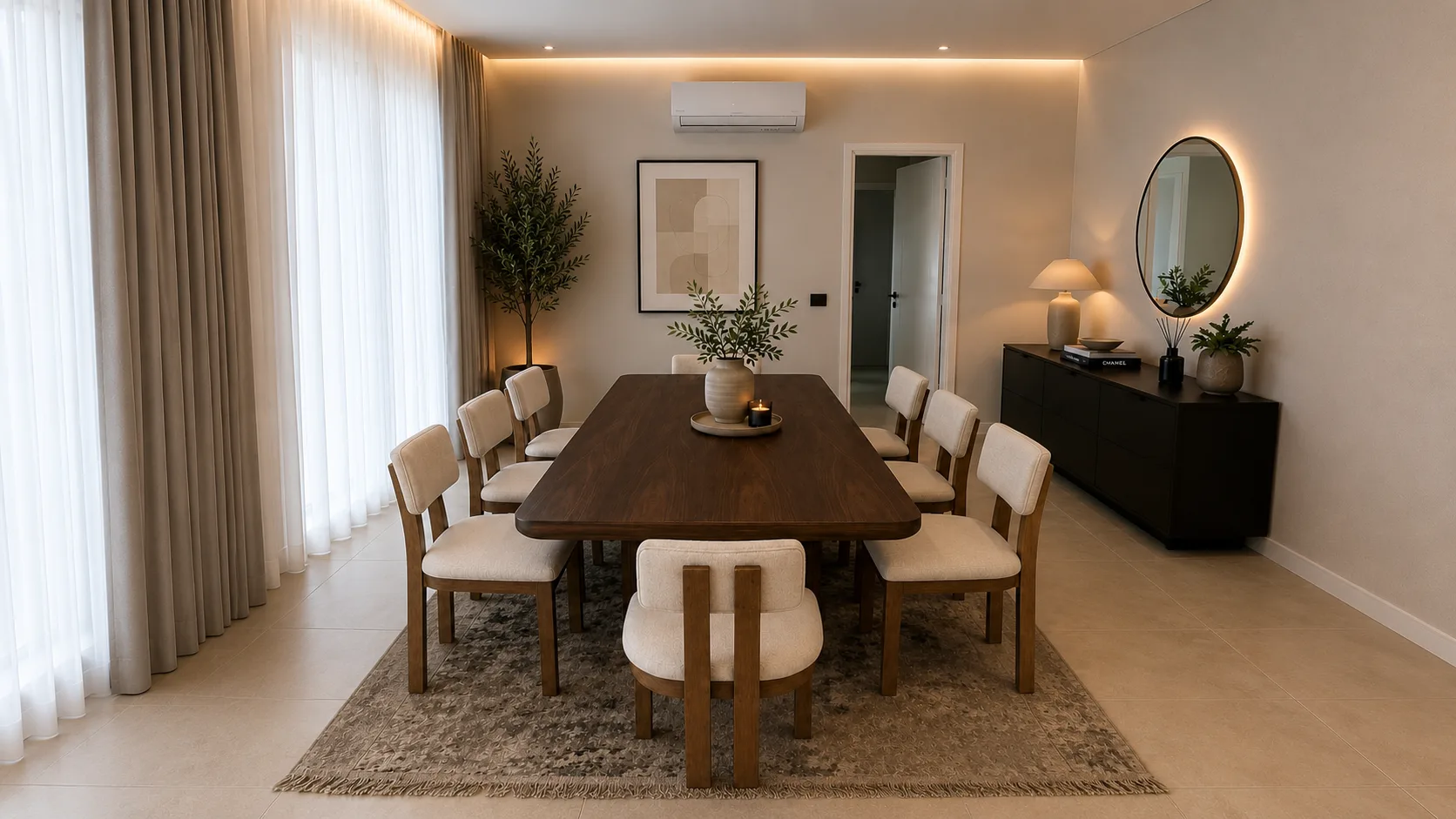
Comfort, height, materials and mixing styles: a practical guide to choosing dining chairs that look good and feel good through a long meal, not just in the photo.

The shape of a dining table decides how many people sit comfortably and how much room is left to walk. When a round table wins, when a square one for four is the right call, and when only a rectangle will seat everyone.
Designer looks, a fraction of the cost