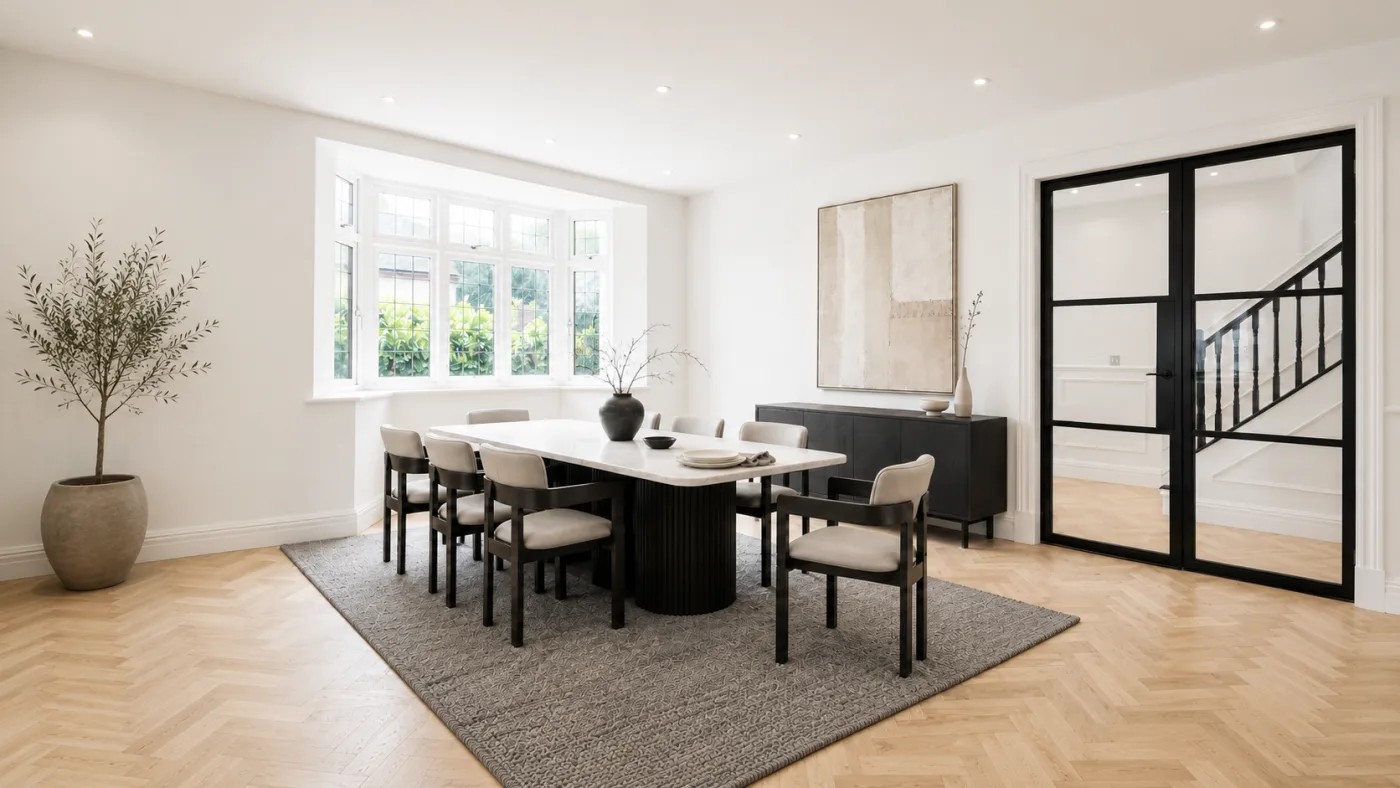
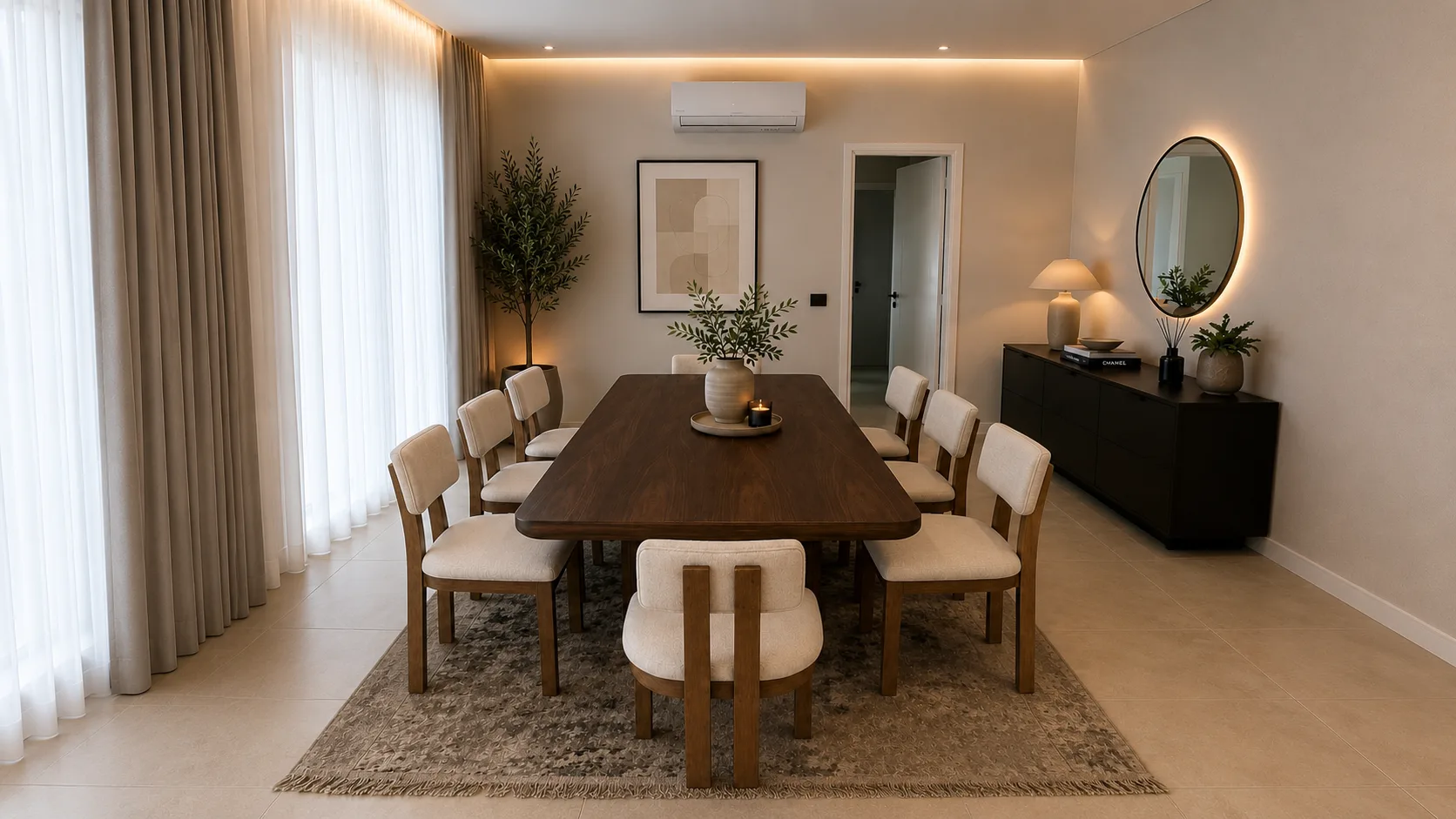
Most people choose dining chairs by looks and count them by guesswork. Then the set arrives, the fourth chair sits half across a table leg, and nobody can get past the person on the end. The maths here is genuinely simple, and doing it first saves the return.
Start with 60cm per person
One number does most of the work: allow 60cm of table edge per person. That is about the width of a place setting plus enough room to move your elbows without catching your neighbour.
You can drop to 55cm for the odd extra guest at Christmas. Below that, people start apologising to each other between courses.
Note that this is table edge per person, not chair width. Those are two different measurements, and the gap between them is where most mistakes happen. More on that below.
Rectangular tables
Divide each long side by 60 and round down. Then add one seat at each end if the table is at least 80cm wide.
| Table size | Per long side | Ends | Comfortable total |
|---|
| 120 x 80cm | 2 | 1 each | 4 to 6 |
| 150 x 90cm | 2 | 1 each | 6 |
| 180 x 90cm | 3 | 1 each | 6 to 8 |
| 200 x 100cm | 3 | 1 each | 8 |
| 240 x 100cm | 4 | 1 each | 10 |
Where a range is shown, the lower number is the everyday setting and the higher one is what you can manage when everyone is being friendly.
Round tables
Round tables tend to seat more people for the floor space they occupy, because there are no corners going to waste. The sum is the same, you just need the circumference first.
Circumference = diameter x 3.14. Then divide by 60.
| Diameter | Circumference | Seats |
|---|
| 90cm | 283cm | 4 |
| 100cm | 314cm | 5 |
| 120cm | 377cm | 6 |
| 140cm | 440cm | 7 |
| 150cm | 471cm | 7 |
A 120cm round table seating six in the same footprint that a rectangular table would seat four is why they work so well in square rooms.
Watch the corners and the legs
Two things quietly steal seats.
Corners. On a rectangular table, nobody wants to sit with a corner in their lap. Keep chairs roughly 15cm clear of each corner, which is why a 120cm side takes two people rather than the two-and-a-bit the sum suggests.
Table legs. A traditional four-legged table puts a leg near each corner, and that is exactly where an end chair wants to go. Pedestal and trestle bases avoid the problem entirely, which is worth knowing if you are buying the table and the chairs together.
Then check the chair itself
The 60cm rule spaces people. It does not tell you whether the chairs physically fit side by side, and that depends on the chair.
Across our own range the widths run from 43.5cm to 56.5cm, which is a wider spread than most people expect. At the narrow end a chair sits in a 60cm slot with a comfortable gap either side. At the top end, the Henley Scandi chairs are 56.5cm across, which leaves only a few centimetres between neighbours at the same spacing. Wider chairs are lovely to sit in and they do cost you seats.
So before you order, check the width in the product specification and compare it against your 60cm slots. If a chair is over 55cm wide, plan on giving each person 65cm instead.
Armchairs and carvers need the same check twice over, because the arms have to clear the underside of the table as well.
Leave room behind the chair
Seating people around the table is only half of it. They have to get in and out.
- 75cm from the table edge to the wall or the nearest furniture. This is the minimum to pull a chair back and sit down.
- 90 to 100cm if someone needs to walk behind a person who is already seated.
- 120cm if that gap is the main route through the room, or a doorway opens onto it.
Measure this before you count seats, not after. A 200cm table that seats eight on paper seats six in practice if two of those chairs cannot be pulled out.
Benches change the sum
A bench along one side ignores the 60cm rule, because there are no chair backs to space. You can usually fit one more person on a 180cm bench than on the same length in chairs, and you can slide it fully under the table when it is not in use, which is worth a lot in a narrow room.
The trade is comfort. Nobody has a back to lean on, so benches suit breakfast and family meals better than long dinners. Plenty of homes run a bench on the wall side and chairs on the open side, and get the best of both.
A quick worked example
A 180 x 90cm table in a room 300cm wide.
- Long sides: 180 ÷ 60 = 3 seats each, so six.
- Ends: the table is 90cm wide, so one at each end, giving eight.
- Clearance: the table is 90cm deep in a 300cm room, leaving 105cm on each side. That clears the 75cm minimum and just clears the 90cm walk-behind figure.
- Chair width: at 46cm the Dany chairs fit three to a side with room to spare. At 56.5cm, Henley would be tight at three, so six plus two ends becomes a squeeze.
Eight it is, provided you keep the chairs narrow.
Find yours
Once you know your number, buying is the easy part. Our dining chairs come in sets of two, so most tables need two or three sets, and every order includes free UK delivery and 30-day returns. If you are kitting out a whole table, use Make an Offer and we will see what we can do on the price.
Have a look through the full range of dining chairs, or read our guide to choosing dining chairs you will actually want to sit on for the comfort side of the decision.